Quick Answer: Foot pain from climbing stairs often points to the arch, heel, or big toe joint — the parts of your foot that take the most load when you push off each step. Overuse, tight calves, flat feet, arthritis, or unsupportive shoes are the usual culprits. Rest, ice, calf stretches, and supportive shoes can help. If the pain is sharp, one-sided, or doesn’t improve after a week or two, get it checked.
See a doctor promptly if you notice:
- Sharp or severe pain that makes it hard to walk or bear weight
- Swelling, redness, or warmth in the foot that doesn’t improve after a few days
- Pain in the big toe joint that is stiff, swollen, or hard to bend
- Numbness, tingling, or a feeling that your foot “gives way” on the stairs
- Pain that keeps coming back every time you climb stairs, even after rest
Why Climbing Stairs Hurts Your Feet
Climbing stairs asks a lot of your feet. With every step, you push off with the ball of your foot and bend your big toe joint sharply, while your arch and calf work together to lift your weight upward. That’s a much bigger load than flat walking, where your weight rolls smoothly from heel to toe.
What It Is: The Most Common Causes
Plantar fasciitis is one of the most common causes. The plantar fascia, the thick band of tissue along the bottom of your foot, gets stretched and loaded each time you push off a step. If it’s already irritated, stairs can trigger a sharp ache in the heel or arch.
Big toe joint pain is another frequent culprit. Climbing stairs bends the big toe joint much further than flat walking does. If that joint is stiff or arthritic — a condition called hallux rigidus — each step up can hurt, usually right at the base of the big toe.
Arch pain from flat feet or overpronation also shows up on stairs. When your arch flattens too much under load, the tissues along the inside of your foot get stretched with every push-off. People with flat feet often find that stairs tire their feet out quickly, with an aching feeling along the arch. If your arches ache regularly, our guide to sore arches and their causes can help you work out what’s going on.
Heel pain after stairs can come from Achilles tendinitis, where the tendon at the back of your heel gets irritated by the repeated push-off. The pain is usually at the back of the heel or just above it, and it often feels stiff in the morning. Tight calves make all of these problems worse, because a tight calf pulls on the heel and the arch with every step.
Your shoes play a part too. Flat, unsupportive shoes with no arch support or cushioning pass the full force of each stair step straight into your feet. High heels are even worse — they force your weight forward onto the balls of your feet. If your feet hurt mainly on stairs, your footwear is one of the first things worth changing, as our guide to foot pain from new shoes explains.
What Helps: Right After It Hurts
Start by giving your feet a break from stairs where you can. Use the elevator or a ramp for a few days while the pain settles, and walk on flat ground instead until it eases.
Ice can help in the first couple of days. The Cleveland Clinic recommends icing a sore foot for 15 to 20 minutes at a time, a few times a day, with a thin towel between the ice and your skin.
What Helps: Footwear and Support
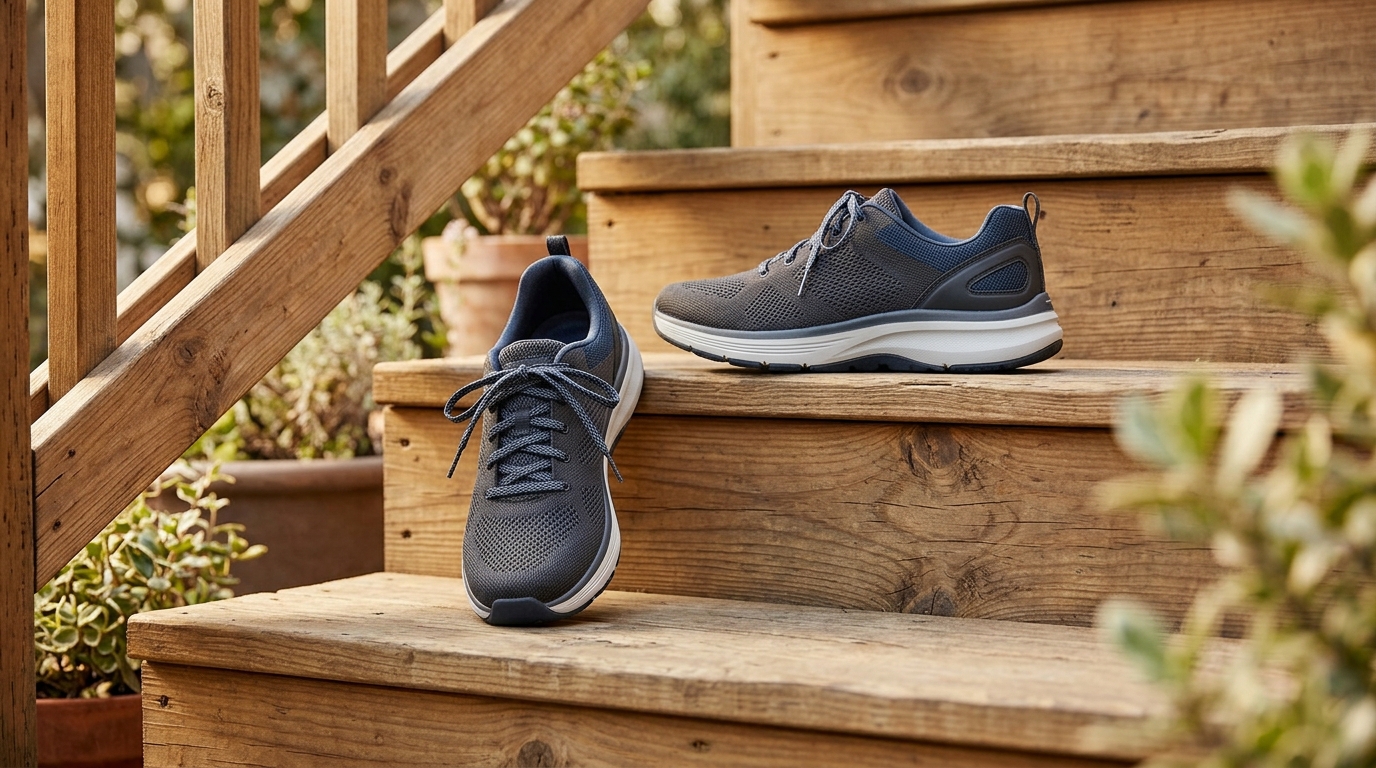
Supportive shoes make a real difference on stairs. Look for good arch support, a cushioned heel, and a firm sole. The Mayo Clinic notes that proper support spreads the load across your foot instead of concentrating it on the heel or the ball.
If you have flat feet or your arches ache on stairs, over-the-counter arch supports or insoles can help. They hold the arch up during the push-off phase of each step, which takes strain off the plantar fascia. If the pain keeps coming back despite supportive shoes and insoles, a podiatrist can check whether custom orthotics would help.
Stretching your calves daily is one of the simplest and most effective things you can do. Tight calves limit how far your ankle can bend and force your foot to compensate. A wall calf stretch, held for 30 seconds per leg morning and evening, can make stairs noticeably easier within a couple of weeks.
Your Daily Routine
Here’s a practical routine for keeping your feet comfortable when stairs are part of your day:
- Morning stretch: Stretch your calves before your first flight of stairs — a wall calf stretch for 30 seconds per leg takes two minutes.
- Take stairs one at a time: Place your whole foot on each step rather than just the ball. It spreads the load and keeps the big toe joint from bending too far.
- Use the handrail: A light touch on the rail takes a little weight off your feet and steadies your balance.
- Ice after a stair-heavy day: If you’ve been up and down stairs a lot, ice the sore area for 15 minutes in the evening.
- Wear supportive shoes: Keep your supportive shoes on for stairs, even at home. Going barefoot on hard stairs puts the full load on your arch and heel with no cushioning at all.
FAQs
Why do my feet hurt when I climb stairs but not when I walk?
Stairs load your feet much harder than flat walking — each step bends the big toe joint sharply and loads the arch and heel as you push upward. Problems like plantar fasciitis or a stiff big toe joint often only show up under that extra load.
Is foot pain from climbing stairs serious?
Usually it’s an overuse problem that eases with rest, stretching, and better shoes. But sharp pain, swelling that doesn’t improve, or pain that keeps returning despite rest should be checked by a doctor.
Can flat feet cause pain on stairs?
Yes. When your arch flattens too much under load, the tissues along the inside of your foot get stretched with every push-off, which can cause aching in the arch after climbing stairs.
Should I avoid stairs if my feet hurt?
Cut back on stairs for a few days while the pain settles, using a lift or ramp instead. Once it eases, go back gradually — one flight at a time.
When should I see a doctor about foot pain from climbing stairs?
See a doctor promptly if the pain is sharp or severe, if you can’t bear weight, if the big toe joint is stiff or swollen, or if the pain keeps returning despite rest and supportive shoes.
Sources
- Mayo Clinic — plantar fasciitis and Achilles tendinitis information
- Cleveland Clinic — foot pain causes and footwear guidance
- American Podiatric Medical Association — arch pain and overuse injury guidance
This article is for general information only and is not medical advice. Talk to your doctor or a podiatrist about your own feet.